6/9/10

Helping Clients Visualize

As design professionals we often forget that we have developed an ability to visualize the un-built. I have attended design presentation where project architects gloss over the as-built plans (existing condition drawings) for a client's home because the architect/designer assumes the client can visualize it... Most often the client cannot. And, often the architect/designer underestimates the value of their visualization skills.

At Wentworth, Inc. we have helped our clinets visualize, to "see", what we have designed for them. Here are three examples of how we do this for our clients.

3-D Computer Modeling

With the aid of 3-D Computer Modeling our staff create interior and exterior perspectives to help clients understand the design and know how it will look, feel, and perform. We illustrate the three dimensional design on the computer screen or in a printed form for the client to take home. Computer software allows us to move around an imagined interior space and look at it from different perspectives.


Cardboard Study Models

Cardboard scaled study models are a personal favorite of mine. As a kid I built hundreds of cardboard house models for my train set villages and became skilled at it. Now I built them for our clients. I typically use foam core to create the building site with its slopes and contours. I learned that a good scale for a residential study model is for every one foot to equal 1/8". Typically I use water color paper, Elmer's glue, and an X-acto knife to build simple massing models. For a project involving an addition to an existing home - I build the existing house first; the proposed design for the addition are done as plug-and-play components. I have found that this is a good way to help clients visualize how their house will look in terms of the roof lines and forms. A few years ago a study model for a new home in Arlington clinched the design decision with its large sweeping hip roofs and sexy dormers.

Full Scale Mock-Ups
Without a doubt, clients love our full scale mock ups. We love them too, and we have done a variety over the years.

For an Alexandria project involving a fron porch & facade remodel our carpenters created 2' x 2' panels to illustrate three different wood wall cladding treatments. It helped the client to make the right choice for them. A) Narrow strips- for the "country look", B) raised panels with beveled edges- for the highly "formal look", or C) layered recessed panels with molding, and the perfect fit for our client. The client felt it provided the best mix of detail, not too formal and not too rustic.

A project currently under construction in Chevy Chase, Maryland involves a large kitchen and family room remodel. The clients admitted that they had trouble visualizing how it would all come together with a central island and the surrounding cabinetry. Their fears were normal for a homeowner who thought the space might be too tight. To get a comfort level prior to the cabinet mockups from 1/8" hardboard. With a few minor adjustments the client felt comfortable to proceed. The cabinet mock up provided a solid comfort level for the homeowner who had difficulty visualizing the final product.


For more information, or for visualizing your next remodeling project, check out our website, www.wentworthstudio.com

6/1/10

Credentials Matter

What to look for in your residential Design/Build firm
By Bruce Wentworth, AIA

When I started my firm in 1986 I could never have imagined where business requirements would evolve in 2010. Being licensed as an architect and contractor are important and a company’s credentials matter; probably more now than in 1986. The internet allows emerging businesses to look professional and upscale with a website; but look closely to see if they carry the proper credentials and experience to do the work they purport to do. It’s easy to be fooled by a fancy website. Here are important credentials to look for when selecting a residential remodeling company.

1. Licensed Contractors: Is the firm licensed as a Home improvement Contractor? Are they legally entitled to provide the remodeling service their website promotes? The Washington, DC metro area is more complicated than a single state area; to work in the tri-state area, we need licenses in Maryland, DC, and Virginia. Maryland and Virginia have exams, and all three states have fees and insurance requirements that must be adhered to. Visit the website for your state to determine whether the contractor you are considering is properly licensed.


2. Licensed Architect: There are many firms providing residential design services who are not licensed architects. Some of those designers are good and some are not. Knowing that the remodeling firm you select to do your home remodeling has licensed architects on their staff can make you feel confident that the design will be good and meet code requirements. Because of the complexities of construction some jurisdictions are beginning to require that plans be prepared by a licensed architect. At Wentworth we take pride in seeking design excellence with cost effective solutions. You can visit your state’s website to learn if your designer is a licensed architect. Maryland, Virginia, DC.

3. EPA Certified for Lead Paint Renovation: On April 22, 2010 the United States Environmental Protection Agency implemented new requirements that require representatives from the firm to take a 10 hour course, pass an exam, and become certified in conducting lead-based paint renovation. 40CFR Part 745.89. After a key person with the organization, in our case two, is certified the firm then pays a $300 fee to the EPA and becomes certified. People most at risk for lead poisoning are children under the age of six and pregnant women in homes typically built prior to 1978. Visit the EPA website to see who is certified for this remodeling work in your area.

4. Professional Associations: AIA, NARI, And ASID: If the owners of the company you plan to hire are members of professional associations it’s a good indication of their commitment to their profession. Most associations offer educational opportunities to help their members learn more and expand their skill base. The American Institute of Architects, (AIA) has over 83,000 members nationally and requires that their members study to obtain 18 learning units each year to remain a member of the AIA and up to date with the field. The National Association of Remodeling Industry (NARI) has local chapters that promote education and networking between members. Their annual awards competition (Contractor of the Year or COTY) promotes excellence through their awards locally and nationally. The American Society of Interior Designers also promotes education and professional development. Many states are now requiring that interior designers become licensed professionals to remove the stigma of “interior decorator”.

5. Insurance: Verify that the firm you hire for remodeling is insured with at least $2,000,000 of General Liability coverage. Companies should also carry worker’s compensation and employer’s liability. Request a Certificate of Insurance as evidence of their coverage. Even with the best of intentions and with the most professional firms there is risk. Be insured.

6. Design & Remodeling Experience: Once you have satisfied the basic credentials listed # 1 thru 5 you can start to examine the firms design and remodeling experience. Are they good designers? Do you have rapport with the design team? Will their designs provide good value for a realistic budget? Study their portfolio and speak with past clients. Is their construction team skilled with remodeling? Remodeling is often more complicated than new construction. Are the carpenters skilled and concerned with craftsmanship? Do they plan ahead and schedule the work? Visit a job site and speak with their references.

7. References: References are important. Typically three are provided so that you can call and speak with past clients of the firm. If it is not too much trouble you might ask the firm if you can visit a remodeling job site they are currently working at.

8. Be a good client: Remember that being a good client will help you to get a good remodeling project from the firm you select. Review your drawings thoroughly to know what is included and what is not. Respect the integrity of your written contract and architectural plans. Show up for meetings on time. And if you are happy with the work – refer your friends and colleagues for their remodeling work. It’s simple.

For more information about the well credentialed team at Wentworth Studio, check out www.wentworthstudio.com

5/5/10

A Dedicated Staff of Carpenters

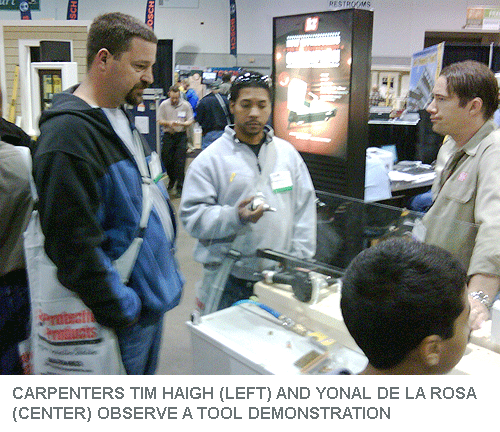
Education is Important. At Wentworth we encourage staff to attend events where they can learn to be better remodelers for our clients. Our Production Manager, Steven Barnard, is especially keen on these opportunities and for the second year in a row attended the JLC Live Residential Construction Show in Providence, Rhode Island March 20-21, 2010, along with our carpenters Yonal De La Rosa and Tim Haigh.

Organized by the magazine, Journal of Light Construction, the show features useful information about products, tools and techniques. Hands-on building clinics and classroom education round out the hundreds of product display booths. JLCLive prides itself on being the leading construction event serving the residential sector bringing construction professionals face-to-face with manufactures, distributors and service providers while providing education through live, interactive demonstrations, and a comprehensive conference program.

In 2009, while attending the JLCLive show, our production manager discovered a new product, Bison Deck Supports, which provides variable height roof deck supports for pre-made IPE wood decking tiles. Wentworth utilized this product for a remodeling project in Northwest Washington, DC. Sure evidence that the time was well invested.


Dedication to continual improvement and training allow the Wentworth staff to excel in our construction services; A true benefit for our remodeling clients.

To see more of this project visit our website at www.wentworthstudio.com

4/19/10

A Civilized Shopping Center - Chevy Chase Lake

The offices for Wentworth, Inc. www.wentworthstudio.com are located at the Chevy Chase Lake shopping center at the corner of Manor Road and Connecticut Avenue in Chevy chase, Maryland. Our design sensitive staff appreciates the nice office environment. We like our second floor space with windows on three sides for eastern, southern, and western exposures, and appreciate the natural light and the convenience of the small scale complex.

Our landlord, the Chevy Chase Land Company, takes good care of their investment. The property gets its name from the former man-made Chevy Chase Lake amusement park which was just to the south of the complex. I get a kick knowing that my father visited the amusement park while he was growing up in College Park, Maryland.

Our residential clients even like coming to our offices because of the easy parking on the surface lot and the understated but charming environment. Many of our clients have remarked at the charm of the older brick buildings with the wrought iron canopy supports. The Chevy Chase lake complex was built in the late 1950s or early 1960s and was designed by an architect who was sophisticated with the Colonial Revival style.

The complex consists of two buildings, one larger building for the super market, and a second smaller two-story building, for the retail & office space. Although the shopping center is of modest scale by today’s standards, these buildings feature solid masonry construction, brick arches, crown and dentil details, slate shingles for the roofs and double hung windows for ventilation. All of which provide a quaint human scale.

The architect was thoughtful in his use of protective canopies for rain and sun. Each building has a covered area along its main façade and the two are linked by a free-standing arcade that protects pedestrians from rain, snow and sun. When it rains I can get half way to my car without getting wet. The free standing canopy visually breaks up the parking lot so it does not feel like a hulking asphalt lot. The complex of small brick buildings will eventually be replaced with something larger…but for now we can enjoy what we have.

To learn more about Chevy Chase history visit www.chevychasehistory.org To learn more about Wentworth’s design/build services, visit www.wentworthstudio.com

4/8/10

Prioritizing Your Home Remodeling Projects

By Bruce Wentworth, AIA

Homeowners are budget conscious when making home remodeling decisions. Wentworth can help you make these often difficult or confusing decisions at an in-home consultation, where priorities, design concepts, and construction issues can be clarified. Budget-minded simply means allocating financial resources in the best possible way. Excellent design solutions, coupled with quality craftsmanship and materials, are still a smart long-term home investment.

A well-located Washington area home remains a solid investment. After three decades in business, I can offer these tips to improve home value.

1. Kitchens: Kitchens more than 25 years old are functionally obsolete and aesthetically outdated. A well-designed kitchen enhances home value and improves family life.


2. Bathrooms: A well-designed master bath is an excellent investment, although cosmetically upgrading older baths will also improve home value.


3. Facades: If your home lacks curb appeal, exterior façade enhancements will add value. A new front door, windows, a front porch, or other architectural embellishments, all sensitive to your home’s architectural style, can be considered.


Thoughtful design analysis of your home makes appropriate, cost-effective remodeling decisions a reality. Call for a consultation today 240-395-0705 x 100.

EPA Sets Lead Paint Safety Requirements For Contractors

Wentworth, Inc. is now an EPA certified renovator to lead safety for renovation, repair and painting (RRP).


Bruce Wentworth, President and Steven Barnard, Production Manager, have both taken the 8 hour, 8 module course offered by The Training Network and accredited by EPA/HUD. Certification is good for five years at which time a refresher course shall be taken. EPA requirements became effective April, 22, 2010.


Lead paint in the United States was banned in 1978 and homes built prior to that typically used lead paint. Alterations to homes with lead paint are to be handled in approved ways primarily for the safety of children under the age of 6 and pregnant women.


The hazard areas are often: a. peeling and flaking lead paint, b. friction surfaces such as the bottom of a sash window, c. impact surfaces like treads, risers, jambs, and doors. Prior to commencing remodeling the home shall be tested for lead paint by a certified renovator. If lead paint is found in the area to be remodeled there are standard practices for dealing with the removal of materials, and dust with lead paint. To learn more about lead paint issues in your home read the EPA guide called “Renovate Right” available at www.EPA.gov/lead
Bruce Wentworth, AIACertificate Number R-I-18343-10-00591

3/22/10

And the Winners Are...

The staff at Wentworth loves to win awards for their home remodeling work and be recognized by their peers…so when the National Association of Remodeling Industry (NARI) announced that Wentworth, Inc. (www.wentworthstudio.com) had won four Contractor of the Year awards (COTY) we were all thrilled. The Metro DC Chapter of NARI awarded the Capital Cotys at a black tie event held at the Marriott in Bethesda on January 30, 2010.Wentworth, Inc. was represented at the ceremony by Bruce Wentworth, AIA, President, and Steven Barnard, Director of Construction. Four times they walked up to the podium to receive the award plaques.

Bruce Wentworth, AIA and Steven Barnard
accepting one of the four CotY Awards

Wentworth, Inc. was represented at the ceremony by Bruce Wentworth, AIA, President, and Steven Barnard, Director of Construction. Four times they walked up to the podium to receive the award plaques.
The Remodeled garage is now a family room.

A spacious master bath

Custom details

A facade remodel